
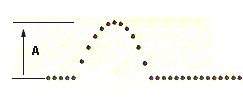
A single transverse pulse with amplitude A and vertical particle motion moves to the right.
A series of transverse pulses forms a wave of wavelength l and amplitude A.

A longitudinal pulse with particle motion in the direction of travel may pass along a stretched spring.
Longitudinal pulses are observed on slinky-type springs and are most commonly encountered as sound waves (compression waves) in air, water, steel etc.
A series of longitudinal pulses forms a wave in the same way as a series of transverse pulses. Because the particle displacements (forward and back) are in the direction of travel it is not possible to represent the wave with a static diagram that represents the physical situation. Traveling and standing sound waves are longitudinal in nature, but they are represented in diagrams in the same way as transverse waves. It is important to recognize that diagrams representing longitudinal waves do not correspond to the physical situation.
A pulse reflects from a closed boundary on the opposite side (with a phase change of 180°).
The detailed reflection process can be understood by considering what happens to a rubber rope. At a closed boundary the small part of the rope attached to the wall is momentarily stretched more than it is as the pulse passes down the rope. The stretched portion then contracts strongly, sending the pulse back on the other side of the rope.
A pulse reflects from an open boundary on the same side (with no phase change).
The detailed reflection process can again be understood by considering what happens to a rubber rope. The end of the rope flicks outwards further than the pulse amplitude. Restoring forces then pull the end back, driving the reflected pulse back on the same side of the rope.
A wave is a series of pulses. Waves have amplitude, wavelength, frequency and velocity. In a transverse wave, the medium oscillates at right angles to the wave motion. Each point performs what is known as Simple Harmonic Motion. The motion is the same as the motion of a mass oscillating on a light spring.
Waves reflect in the same way from both closed and open boundaries.
A wave reflecting from a closed boundary overlaps the incoming wave. The pulse that would have been beyond the barrier is reflected with a phase change!
A wave reflecting from an open boundary also overlaps the incoming wave. The part of the pulse that would have been beyond the end is reflected without a phase change!
There is a simple relationship between wavelength, velocity and frequency, which holds for any wave.

Any wave travels a distance l in a time T, the period of the driving oscillation. Wave velocity is distance over time.
Since....
... at once....
Note: f is the frequency of the wave generator.... independent of any subsequent velocity and wavelength changes due to changes of medium.
When two displacements are present in the same medium at the same time the displacements add, if the amplitudes are small and the properties of the medium remain unchanged. Under these very common conditions, when two waves have the same amplitude velocity and phase, adding the waves gives a single wave of twice the amplitude.
Note: the medium in which the waves travel is said to be linear when.A+A = 2A, and the waves are then accurately represented by linear equations. Sound waves in air, ripples on water, and the harmonics present on a vibrating violin string are common examples of waves that are described by linear equations.
Shock waves are of large amplitude and their presence may alter the properties of a medium. In that case A+A is not equal to 2A. The conical 'wake' responsible for the sonic boom when a plane flies faster than the speed of sound in air is a shock wave.
When otherwise identical pulses, one positive and the other negative, overlap, the medium is momentarily undistorted. The physical situation is interesting. PE stored in the distorted medium is transformed for a short time to the KE of rapid particle motion.