A model of an ideal gas is shown at right.
For a discussion of the gas laws for an ideal gas open a new window by clicking this link....
A cylinder contains a mass of ideal gas. No air surrounds the cylinder. The pressure of the gas supports the weight of the piston.
The piston is driven up and down in the cylinder. The famous imagined cycle (due to Carnot) has two perfect isothermal changes (which follow Boyle's Law) and two perfect adiabatic changes which change the gas temperature suddenly.
The changes are plotted, as they happen, on the PV diagram.
Step 1
Isothermal compression at T1.
Heat flows to the surroundings. The temperature of the gas (internal energy) remains the same.
Step 2
Adiabatic compression ... warms the gas to T2.
Step 3
Isothermal expansion at T2 (the higher temperature).
The temperature of the gas (internal energy) remains the same. Heat flows into the gas from the surroundings.
Step 4
Adiabatic expansion ... cools the gas to T1.
Carnot engine
The repeating cycle
is that of an ideal Carnot engine.
Note: The Carnot cycle is theroetical reversible cycle that cannot be realized in practice becaue of turbulence and friction.
1 Any part of the cycle can be driven in the opposite direction. Each part of the cycle is reversible. The gas is returned to its original state at its staring temperature. The change on internal energy around the closed loop is zero.
2 Heat Q2 is supplied to the gas at the higher temperature.
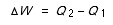
3 A smaller amount of heat Q1 is expelled from the gas at the lower temperature. On completing the cycle in the direction shown, we can write the first law of thermodynamics as....
Q2 is bigger than Q1 so (Q2 - Q1), the work done by the gas, is positive.
Work is done by the gas. The clip shows an ideal Carnot engine which converts heat, (Q2 - Q1), to useful work, DW.
The work done per cycle, DW, is the area of the loop on the PV diagram. The area is in Joules, when pressure is measured in Pascals (Newtons per square meter) and volume is measured in cubic meters.
For a discussion of the importance of reversibility open a panel by clicking this link ...
For a discussion of irreversible processes and entropy open a new window by clicking this link....
Carnot efficiency
A change in entropy DS is defined as....

Around the reversible cycle of the Carnot engine the ideal gas is returned exactly to its original state. For the Carnot engine the change in entropy DS around the cycle must be zero.
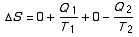
At once.... DS is the same for each isothermal process.

The efficiency of any engine is defined as the work done, DW, over the heat input, Q2. [Q2 is the heat that must be paid for].

Substituting (Q2 - Q1) for DW gives at once; for a Carnot engine....


Substituting for the ratio Q1/Q2 gives at once; for a Carnot engine....
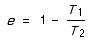
The efficiency of the Carnot Engine is always less than 1, unless the temperature of the cold reservoir, T1, is zero Kelvin, (which cannot be realized in practice).
Remarkably, it can be shown that the efficiency of all real engines is less than that of the ideal Carnot engine. We now understand why a steam engine operating with hot and cold reservoirs at 700 and 300 K respectively has an efficiency less than....

... which is the Carnot efficiency.
Note: real steam engines operate on less efficient cycles than the Carnot cycle and have efficiencies of around 0.3 (30%).
The concept of the thermal nuclear power station is very simple. Fuel rods, which together contain enough radioactive material to set up an uncontrolled chain reaction, are inserted into a moderator that slows the reaction rate.
1 Large amounts of heat are produced in controlled conditions.
2 The heat boils water.
3 The steam runs a steam engine.
4 The steam engine turns a generator that generates electric current.
The present generation of thermal power stations operate at around 300°C. The next generation, planned to be in operation in 20 years from now, are designed to be more efficient - operating at 800-1000°C - with improved safety features, less nuclear waste, and less plutonium for making bombs as a by-product. We live in hope.
| Sadi Carnot's remarkable contribution to physics and engineering lies in the calculation of the maximum possible efficiency of a heat engine. All real engines have inferior efficiencies. The calculation also points the way to improving efficiencies by separating the operating temperatures as much as possible by increasing the high temperature and reducing the temperature of the cold reservoir. The efficiency formula is most easily remembered by noting that as the lower temperature T1 tends to zero, the efficiency approaches unity. |
Example
Watch the animation.
1 Identify the isothermal lines at temperatures T1 and T2.
2a Describe the temperature changes as the ideal gas is taken around the loop.
b Which processes are adiabatic?
3 Watch carefully the direction of travel around the loop. Is the gas doing work - an engine - or is work being done on the gas - a refrigerator?
4 Find the efficiency of the Carnot engine if the temperatures are....