Check Test 1 - Waves 1
1 Which of the following phenomena can be described using Huygens' principle?
a Diffraction at the edge of a shadow.
All of the above
2 Which of the following can be understood by the application of Huygens' principle.
Any point on a wave can be considered to be a source of new waves.
3 Huygens' principle is best described as ...
... a geometrical construction.
4 As light passes from air to a more optically dense medium like glass, the wavelength changes. The substance in which the wavelength of red light is the shortest is ...
... diamond.
5 Light enters sapphire of refractive index n from air.
The angle of refraction in the sapphire is given by....
... r = sin-1(sin i / n)
6 Which of the following completed statements is incorrect?
When gel crystals are immersed in water they disappear (cannot be seen) because....
... both gel and water are equally transparent.
7 When light passes from water to glass with an angle of incidence (in the glass) of 60° it bends with a particular angle of refraction.
The bending is... The angle of refraction is... ... away from the normal. ... greater than the angle of incidence. ... away from the normal. ... less than the angle of incidence. ... towards the normal ... greater than the angle of incidence. ... towards the normal ... less than the angle of incidence.
8 Which of the following completed statements is incorrect?
a ... rays are always straight lines.
9 When drawing ray diagrams u and v stand for, respectively....
c .... the distance from the lens to the object and the distance from the lens to the image.
10 Which of the following statements is correct?
A real image is usually described in this CD as being 'hot'.
11 The method of no parallax is used....
d ... when no more convenient method is available.
12 The focal length of a convex lens is most easily determined by....
... focusing an image of the Sun on a wall and measuring the image distance.
13 Which of the following statements is incorrect?
The position of the image of a point source in a plane mirror can be determined....
... by the principle of superposition.
14 Lateral inversion makes the image of a right foot appear to be....
... a left foot.
15 A point source is imaged in a right-angle corner in a ripple tank.
How many images are formed?
... 3
16 A point source is imaged in three mirrors, forming a three dimensional right angled corner.
How many images are formed?
... 7
17 A student looks carefully at the image of his brightly lit face in the mirror on his bathroom door. He sees a faint second image, displaced by a small amount.
The second image is caused by....
... partial reflection
18 The image of a real object in a convex mirror is....
... upright, virtual and diminished.
19 The main element of a reflecting telescope is always a parabolic, (not spherical), mirror because....
... parabolic mirrors have an exact focal point.
20 Which device would be most suitable for creating an all sky image?
A convex mirror.
21 A mirror used with a high quality sound recording device used for high frequency sounds (bird song) may not have surface irregularities that are greater than....
... 1 mm in extent.
22 The thin lens formula applies to....
... thin spherical lenses and mirrors only.
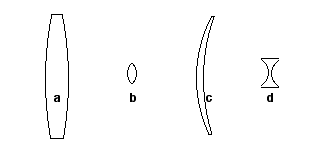
23 Which of the lenses shown might be considered to be thin?
.... a and c only.
24 The focal point of a plane mirror is ...
... at infinity.
25 Which of the following is/are required to derive the thin lens formula for a convex lens?
All of the above.
You may find it helpful to print this test