
Elder Zer: 2008
Introduction
Craters are a familiar sight on the moon (Figure 1). The size of a crater may be due to many factors, including the size, shape and density of the impacting object, and the composition of the surface.
Research Question
What is the relationship between the energy of an impacting steel ball and the crater formed in compacted sand.
Hypothesis
The relationship between the kinetic energy of a meteor at impact E and the diameter of the resulting crater D on the Moon is ...
... where k is a constant. The energy E is raised to the power of 0.59.
It is expected that the diameter of the craters formed in sand at low impact energies may also be a power law, but the power is not expected to be 0.59 as it is for high energy meteor cratering.
Procedure
Quartz sand with grain sizes from 0.5 to 1.0 mm in diameter was placed in a large plastic basin (see Figure 2).
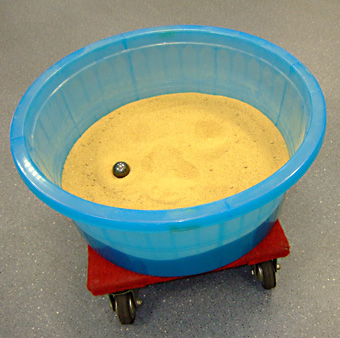 Fig 2 - the bowl, sand, and a steel ball. |
Seven metal steel balls of different sizes were chosen and the mass of each was found with an electronic balance.
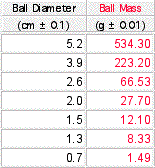
The balls were dropped from three different heights into the sand: from 2.00 meters i the laboratory, from the first floor of a building (5.21 meters) and from the second floor (9.34 meters). Each ball was dropped three times from each height and the diameter of the crater was measured and recorded. Between each drop the plastic basin was shaken to compact the sand and to reform the smooth surface. The average crater diameters for each height and the ball diameters are listed below.
Data
Ball energy and crater diameters
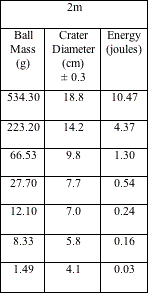
Table 1 - crater diameters and calculated impact energies. Errors are shown for the crater diameters only, since the mass and calculated impact energies are more accurate. The kinetic energy was calculated at the surface of the sand, assuming that all gravitational potential was converted to kinetic energy, and that any additional PE release due to the penetration of the ball into the sand was negligible. Data for drops from five and nine meters is listed in Table 2.
The crater diameters for all three heights were plotted against the calculated energy to find a possible relationship between the two variables (Graph 1).
The power law curves for the greater heights are almost the same within errors and differ significantly from the curve at 2.0 meters.
Discussion
A power law relationship has been found between the crater diameter and impact energy, but as expected, the power is not the 0.59 found for meteor cratering. The power is 0.23±0.1 for impacts due to drops of five and nine meters. A lower two meter drop produced a higher power of 0.28±0.1.
Evaluation and suggestions for further work
The crater diameters were not defined to better than ± 0.1 cm and the craters were not perfectly circular. These uncertainties will be present in any study of this type.
The loss of potential energy was calculated to estimate the kinetic energy of the ball at impact with the sand. The loss of energy due to air resistance would be larger for longer drops since the drag force is proportional to velocity squared, but for nine meter drops of steel balls it is still an insignificant fraction of the total energy.
It would be interesting to compare crater diameters in iron sand, sawdust, mud and other materials to determine whether the power laws found here are independent of the cratering material.
It would also be interesting to examine the craters formed at higher energy impacts by using higher drops of by firing steel balls or bullets into sand with compressed air guns or similar.