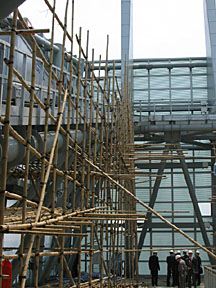
 Fig 1 - Bamboo construction scaffolding. |
Nikhil Aima: 2005
Introduction: background information
Bamboos are a group of woody perennial evergreen plants in the true grass family Poaceae, subfamily Bambusoideae. Bamboo is divided into 75 genera and has some 1250 species with varying sizes. These are giant, fast-growing grasses that have woody stems. Indigenous to much of the world, from tropical and sub-tropical to mild-temperate regions, there are species native to the Americas, to Europe and to Africa, but greatest concentration and most spectacular proliferation of bamboos is in the Far East and Southeast Asia, where giant timber bamboos grow to over 40 m. Bamboo is used for furniture, fences, bridges and construction scaffolding.
|
Fig 1 - Bamboo construction scaffolding. |
Research Question
Does the length of a bamboo stick dictate the flexibility of the bamboo? Is there a relationship between them?
Hypothesis
When the stick is shortened by moving the clamps closer to each other, the stiffness of the stick increases and therefore its deflection when loaded reduces. This is because the bamboo becomes stiffer when the length is reduced and therefore, its flexibility reduces along with its length.
Apparatus and Procedure
Dependent Variable: The bending of the stick.
Independent Variable: The length of the stick between the clamps.
Controlled Variable(s): The same stick should be used and the point at which the mass is hung is the same for all measurements (the center of the stick).
Two clamp stands
(figure 2) were taken and one clamp was attached on each stand.
A third clamp stand was taken and a ruler was taped onto it, for
the measurements of the bending. After the stands had been set
up, a bamboo stick was taken and placed in between the clamps.
The distance between the clamps was 30.00 cm, therefore the length
of the stick was also 30.00 cm. The unbent position of the center
of the stick was recorded and then masses of 50 g, 100 g, 150
g, 200 g, and 250 g were added to the center of the stick. The
bending caused by the addition of these weights was recorded.
After recording the bending of the stick at length of 30.00 cm,
the stands were brought closer together so that the distance between
the two clamps was 25.00 cm and then the stick was hung between
the clamps and the bending was recorded when 50 g, 100 g, 150
g, 200 g, and 250 g were added to the center of the stick. The
procedure was repeated for lengths of 20 and 15 cm.
Data and Analysis
Data is listed in Tables
1 and 2 and in Tables
3 and 4.
Graphing the deflections against the mass shows that the deflection is proportional (within errors) to the weight. The spring constant (k) in the relationship f = kx is the slope of the lines ... or k may be found by calculation.
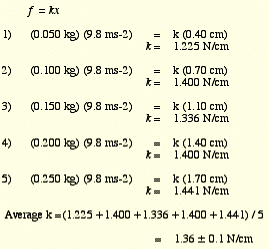
Graph 5 shows
the constant k vs. the length of stick. The relationship between
k and l is an inverse cubic function.
Conclusion and Evaluation
The data from the experiment shows that the flexibility of bamboo
is related to its length. As the length of stick decreases, the
flexibility of the stick reduces and the spring constant rises.
This is what was predicted in the hypothesis that the reduction
in length would make the stick stiffer. The actual relationship
between the spring constant and the length of the stick is that
they have an inversely cubic relationship. The spring constant
of the bamboo is constant (constant at 25.00 cm as, k = 2.45 N/cm)
or very close to constant, when the length is 30.00 cm, k = 1.400
N/cm for two extension measurements and when the length is 20.00
cm, k = 4.900 N/cm for three extension measurements.
The problems in this experiment were mostly in the measurement of the deflection because the position of the stick after the mass was added had to be guessed slightly. To fix this problem and to be sure of the measurement, a thin bar should be placed horizontally on top, above the point at which the mass will be added. Another problem was that the stick seemed to move between the clamps, which kept shifting the center point. To fix this, after the clamps have been moved together to the set length of the stick, the edges of the stick should be taped to the clamps to prevent it from moving.
Research Question
How does the water content in a bamboo stick affect its flexibility? Is there a relationship between them?
Hypothesis
The longer the bamboo is soaked in water, the more flexible
it will become since the absorption of water by the bamboo will
increase its weight and cause it to bend more than usual.
Apparatus and Procedure
Dependent Variable:
The bending of the stick
Independent Variable:
The water content in the stick
Controlled Variable(s):
The same stick should be used
The point at which the mass is hung (the center of the stick)
The distance between the stands with clamps
Two clamp stands were taken and one clamp was attached on each
stand. A third stand was taken and a ruler was taped to it, for
the measurements of the bending. After the stands had been set
up, a bamboo stick was taken and its mass was measured when it
was dry. This stick was labeled as stick 1 for further reference.
Then stick 1 was hung between the two clamps and the measurement
of its bending was taken by adding 850 g, 1000 g and 1750 g. After
the bending was recorded, the stick was soaked in water for 10
minutes. Time was recorded with the help of a stop watch. It was
then taken out and the excess water was wiped with tissue papers.
Its mass was recorded and the stick was then hung between the
clamps. The same sizes of masses 850 g, 1000 g, 1750 g were
added to the stick and its bendiness was recorded. Another stick
was taken and was labeled stick 2. Its mass was taken when it
was 'dry' and its bendiness was recorded by adding 850 g, 1000
g and 1750 g again. This stick was soaked in water for 24 hours.
Time was recorded with the help of a stop
watch. After 24 hours, it was taken out and the excess
water was wiped off. The mass of the 'wet' stick was recorded
and masses of the same sizes were added to its center. The bendiness
of the stick was recorded to complete this part of the experiment.
Data
Values are listed in Table
1a. Close inspection of Table.1a
shows at once that added water does not affect the flexibility
of the bamboo within ±1%.
Conclusion and Evaluation
The data collected by measuring the bending of the stick when dry and compared to when wet clearly show that the bending of the bamboo stick is not affected by the water content in the stick. Within uncertainty, the measurements of the bamboo when wet or dry is approximately the same.
The water does not affect the bamboo's flexibility, which is in contrast to the hypothesis which predicted that water would affect the flexibility as it increased the mass of the bamboo stick and made it weaker that would allow it to extend more in comparison to a dry bamboo stick. Therefore, bamboo can be used in wet areas as its exposure to water will not weaken it and stretch more than it should, but can cause wood-boring insects that can rot the bamboo and collapse the huts made from this wood.