Projectile motion with air resistance
A small basketball is kicked. The path is plotted point by point in Logger Pro. Two complete
trajectories are shown
below. Neither is symmetrical.
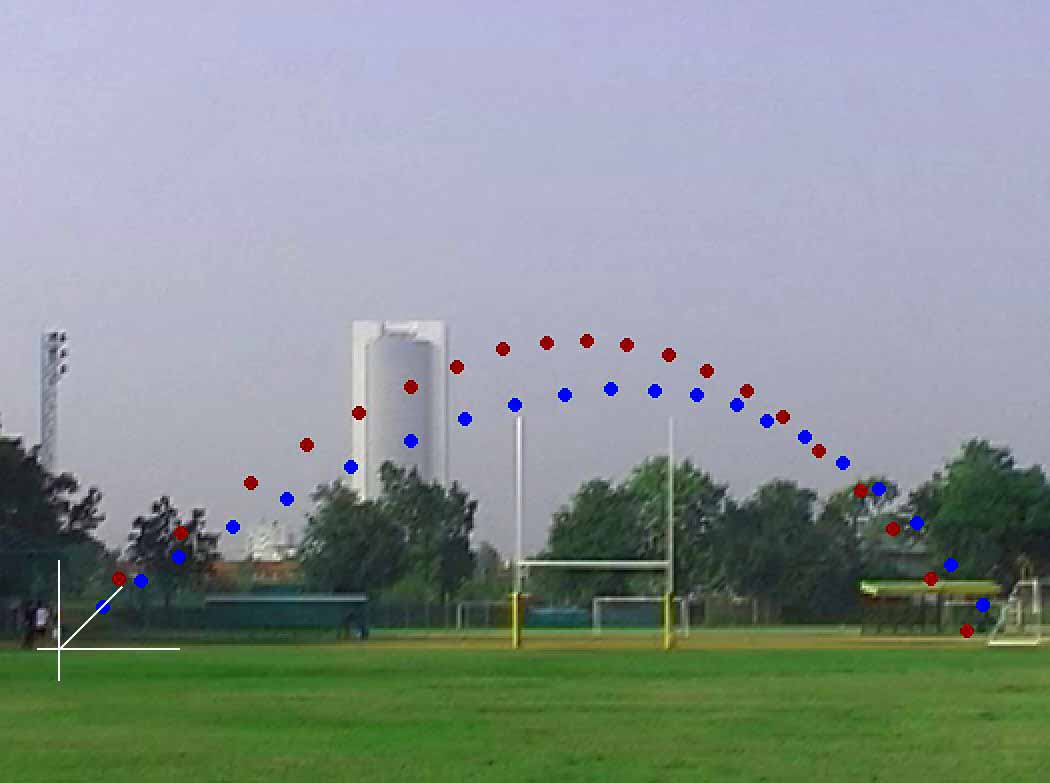
Fitting a parabola to the first part of the curve gives an
estimate of the path
if there were no air resistance.
Plotting the horizontal
velocity for both trajectories shows that air resistance reduces
ux by 50% over the time
of flight in both cases. Plotting the vertical
velocity shows a much smaller effect, because the small force
due to air resistance is added to the much larger weight of the
ball. The vertical acceleration is less than g, the free fall
value of the acceleration due to gravity. This is not a reliable
method for the determination of the acceleration due to gravity
since the scale (marked on the goal posts) is a few meters behind
the actual trajectories.
Suggestions for further work
- It would be interesting to compare the estimate of range
without air resistance in graphs 1 and 2 with calculated trajectories
based on the initial velocity components. [An overlay parabola
is a more convenient way of making the figures for this type
of estimate.]
- The launch velocity could be measured with a radar gun and
compared with the initial velocity determined with the components
from graphs 3 and 4.
- It would be interesting to plot the horizontal acceleration
due to air resistance and to process that data to find the drag
as a function of velocity.
- It might be possible to use a ball launched to develop a
limited empirical model for the range and maximum height reduction
due to air resistance with launch angle for a particular ball
and launch velocity.
- ... or ....
- for a particular launch angle and different initial energies.
Close these frames when finished