1 The path of a cathode ray between the parallel charged metal plates is most likely to be a....
a ... circle.
b ... parabola.
c ... hyperbola.
d ... straight line.
2 Parallax errors are reduced in many applications by....
a ... placing the pointer close to scale.
b ... placing a mirror behind the pointer.
c ... designing instrument panels on a concave base.
d ... all three of the above.
| 3 The parallax angle is defined as angle A,B, C or D? |
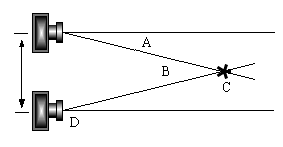 |
4 The distance to two stars with parallax angles of 0.1 and 0.2 seconds of arc respectively is....
a ... 3.26 light years and 6.52 light years.
b ... 3.26 light years and 1.62 light years.
c ... 32.6 light years and 65.2 light years.
d ... 32.6 light years and 16.2 light years.
5 Sample A is paramagnetic and sample B is diamagnetic.
a ... Sample A and B are both attracted to a magnet but with very different forces.
b ... Sample A and B are both repelled from a magnet but with very different forces.
c ... Sample A is attracted to a magnet and sample B is repelled.
d ... Sample A is repelled from a magnet and sample B is attracted.
6 The parsec is....
a ... the only unit of astronomical distance measuement.
b ... based on an ancient Greek measuring system.
c ... an approximate distance measurement.
d ... a convenient measure of astronomical distances.
7 The period of a motion with and an angular frequency of
4p radians per second is....
a ... 4p seconds
b ...1/4p seconds
c ... 4/p seconds
d ... p /4 seconds
8 Which one of the following statements is incorrect?
a ... Nodal lines are formed when two waves are out of phase.
b ... coherent waves are in phase with respect to each other.
c ... a phase contrast microscope is used to examine thin transparent samples.
d ... a light amplifier is called a phasor.
9 The photoelectric effect provided evidence for the existence
of....
a ... subatomic particles.
b ... phonons.
c ... electrons.
d ... photons.
10 A photomultiplier is used for....
a ... the detection of single photons.
b ... the amplification of weak light sources.
c ... the intensification of laser light.
d ... the detection of subatomic particles.