Based in the assumption that light reflected from a water droplet is not polarized the simulation uses Mie Scattering calculation to accurately represent a model rainbow or fog bow. "For a given scattering angle it calculates the Mie scattered intensity which depends on the droplet diameter, wavelength of light and the complex refractive indices of the droplet and surrounding medium."(12) The given result is then adjusted for the intensity of light present at that wavelength. The simulation gives a more accurate rendition of the rainbow that one would see with the naked eye, than a photograph.
The screen resolution of computer monitors prevents the spectral colours from being accurately displayed. It is impossible to reproduce a spectrum perfectly, either digitally or by printing, due to the limitations of phosphors, pigments and inks. The color gamut of computers for example only utilizes three phosphors, Red Green and Blue, further limiting the possibilities of accurate display. In his simulation Les Cowely has developed two alternative color models in an attempt to overcome the color rendition challenges. The most effective, the Bruton Model, is based on an empirical algorithm developed by Dan Bruton. It generates output in RGB gamut components that represent pure spectral colours. The algorithm produces very realistic spectra. The program then adds Red, Green and Blue components to compile the final RGB components for scattering angle. There are still some further challenges that occur like the issues of white balance and individual perceptions. Finally, color representation is subjective, peoples perceptions of the simulations may vary (11).
The following images, created using Les Cowley's simulation program, are the predicted rainbow colours for particular droplet sizes with a standard deviation of ±5%.
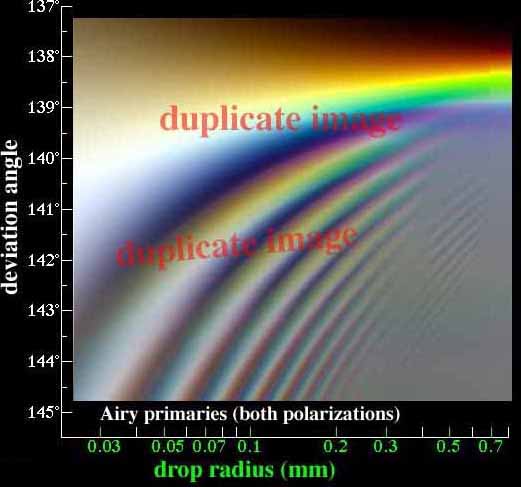
The first simulation with drops of [0.1 mm] radius has very little color, making it appear more like a cloud bow than a rainbow. This suggests that both color and contrast increase with droplet size, which is clearly evident when looking at the Airy disc simulation diagram below, where more intense and varied colours begin to appear for drops greater than 0.1 mm.
In the second simulation with drops of [0.282 mm] radius shows the spectral colours, with Red, a faint Orange, Yellow, Green and a dark Blue now visible. Six supernumerary arcs can still be seen. The third simulation with drops that are [0.40 mm] in radius provides very interesting information towards the argument regarding Newton's color theory. According to the Airy disc simulation diagram, at around 0.3 mm and 0.4 mm, there appears to be a small band of Cyan, suggesting that some rainbows of that size will produce a Cyan like color. To investigate this hypothesis a section of the 0.40 mm rainbow [click here] was enlarged. The simulation shows the six colours Red, Orange, Yellow, Green, Blue and Violet. When looked at closely a gradient of blues can be seen. A small band of Cyan is visible between the Green and darker Blue.
This can be connected to the suggestion by Neils Hutchinson detailed earlier in the essay regarding why Newton included Orange and Indigo. It is first important to note that Newton's theory is in relation to spectra formed by the dispersion of light through a prism. When this occurs, cyan is not apparent, although Newton claimed he did in fact notice a Cyan color during one of his experiments. Newton was unaware of the interference patterns that occur in rainbows, which is what would cause a mixture of colours, appearing to be Cyan, for some specific sized droplets with uniform distribution. In a typical large droplet rainbow Cyan is not visible. It seems that Newton's entirely subjective definition of the color spectrum, according to dispersion of light through a prism, ironically applies more accurately to colours of the rainbow caused by a phenomenon (interference) that Newton was aware of but could not explain.
The next simulation for a droplet size of [0.565 mm] radius presents a very unexpected rainbow. A dark band appears to split the Blue band in the middle, appearing out of place, as it doesn't follow the expected gradient pattern of a normal rainbow. It almost looks like there are 8 different colored bands in this rainbow. According to the Airy simulation diagram, one, faint supernumerary arc appears to exist within this droplet range. From this it is expected that due to interference, a darker band of Blue occurs through the rainbow, which may in some circumstances appear to be Indigo. The position of the band is not as expected, as the sequence of colours appears to be more like Blue, Darker Blue, Blue, Violet.
The final simulation for large [1.60 mm] radius drops presents a rainbow showing the 5 colours Red, Yellow, Green, Blue and Violet. This large droplet bow does not contain an Indigo band.
Note: the simulations can be superimposed in Photoshop to create very realistic effects - more nearly naked eye views than photographs. Note the reduced sky intensity outside the bow known as the Alexander dark space. The bow is formed by the return of light at maximum deviation. Light returned at lower angles lightens the sky inside the bow, creating the impression of a dark space outside.