|
||||||||||||||||||
Formation of Craters in Sand and the Mass of the Projectile
Introduction
When a ball is dropped into sand, a circular crater is formed due to the impact force of the ball. The size of the crater varies directly with impact force. Impact force depends on the mass and velocity of the ball. In this research, the relationship between mass of a table tennis ball dropped into sand and the diameter of the crater formed will be investigated.
Editor’s note: Notice the explanation of the situation being studied and the clear statement of the research question.The size of a crater is related to the amount of energy the projectile possesses as it strikes the ground. The more energy it possess, the larger the crater's diameter. From an internet source, the relationship between energy and diameter of crater was found. The relationship is not linear but rather a power law.
,
(1)
where D is the crater's diameter, Cf is crater collapse factor, ge is gravitational acceleration at the surface of Earth, g is acceleration at the surface of the body on which the crater is formed, pa is density of the projectile, pt is density of the target rock, and E is the total energy of the asteroid (kinetic and potential). (http://palaeo.gly.bris.ac.uk)This equation deals with actual asteroids or comets that collide with the surface of the earth. Our research was conducted with sand and table tennis balls filled with lead shot and latex glue. Therefore, the equation is expected to be slightly different because of the nature of our experiment.
From a different source we found that the relationship between energy and diameter of crater will still be an exponential relationship
(2)
where D is the crater's diameter, E is the total energy of the asteroid (kinetic and potential), k is an unknown constant, and n is an unknown power that describes how the diameter will depend on the amount of energy the asteroid holds. (http://www.astro.lsa.umich.edu)This equation shows the relationship between diameter of crater and energy of the projectile. Assuming that all the potential energy of the ball before being dropped is completely transferred to kinetic energy at the moment the ball hits the sand, the equation for kinetic energy will be,

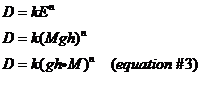
We can see that energy of the projectile is dependent upon mass. When equation 2 is manipulated to include the mass of the projectile, it is as follows:
(3)
Consequently, diameter of crater and mass of projectile is expected to have an exponential relationship as well.Editor’s Note: Note the introduction of relevant theory and its modification to make a prediction of the relationship for this similar situation.